From teaching questions to feasible, evidence-informed SoTL projects
You care about improving student learning — in your own teaching, your programme, or your institution.
You want to work more systematically and evidence-informed.
And you may already be exploring SoTL.
But after the first energy, something shifts.
Your idea stays broad.
Your reading list grows.
Time runs out.
The project moves quietly to the background.
Not because you lack commitment.
But because turning a question into something concrete and feasible is difficult to do on your own.
This is where I can support you.
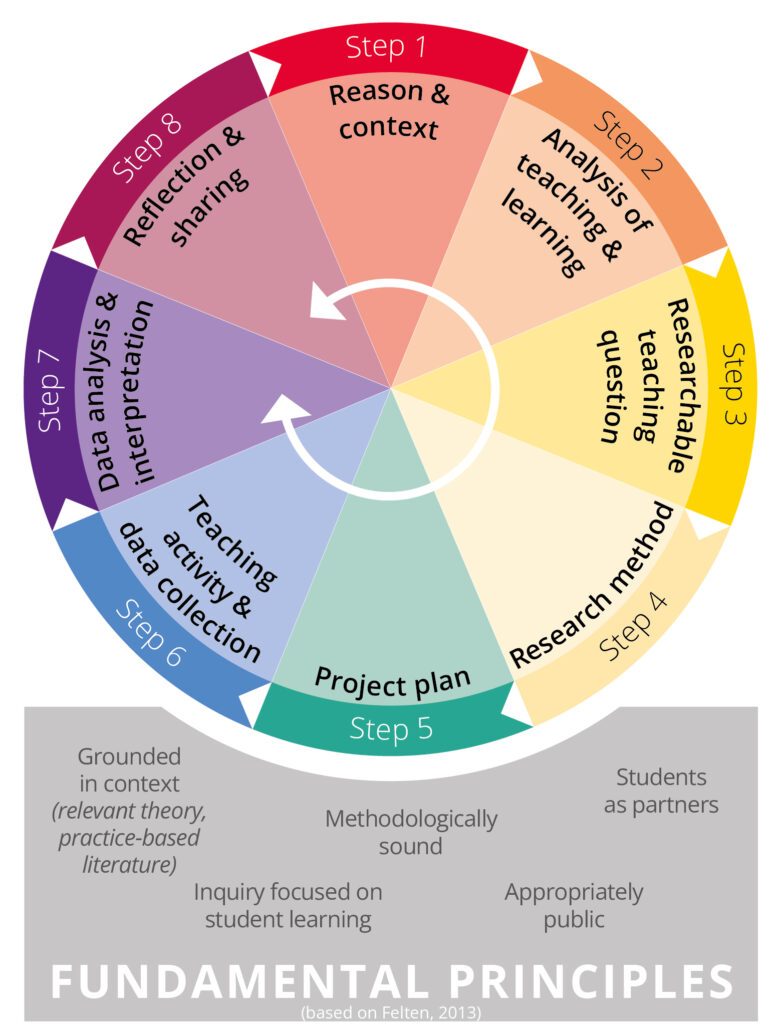
Over more than 24 years in higher education, I have worked with educators, programme leaders and institutes across disciplines. As co-author of the Utrecht University Roadmap for SoTL, I have seen what helps people move forward — and where they tend to hesitate.
Common challenges when starting SoTL
You might have:
- a question about your teaching that keeps returning
- the feeling that something could be improved, but not yet a sharp focus
- uncertainty about how to work with educational literature
- doubts about whether you are “doing it right”
- the intention to start — but not a clear next step
- difficulty making impact on student learning visible
- difficulty connecting individual projects into a coherent whole
Especially if you are a disciplinary researcher, SoTL can feel slightly outside your comfort zone. You are used to rigorous inquiry — but not necessarily in the context of student learning.
You are not alone in that.
Coming from a life sciences background myself, I remember how unfamiliar SoTL initially felt — different literature, methods and questions.
With the right structure and guidance, that transition becomes manageable and genuinely rewarding
SoTL support for educators, programme teams, and institutes
Support is tailored to your role and context — whether you work on your own teaching or on SoTL at programme level.
For Individual Educators
You may recognise this:
- You have a teaching question, but it still feels broad
- You are unsure how to connect your idea to literature
- You want feedback on whether your focus is realistic
- You need structure to move from idea to plan
- You want a critical but supportive sparring partner
With the right structure, your idea becomes concrete and workable.
You see what to focus on — and what to leave aside.
For Programme Teams and Institutes
You may notice:
- SoTL initiatives start with enthusiasm but lose momentum
- Educators work in isolation
- Projects vary widely in focus and quality
- Results remain difficult to connect or reuse
- It is hard to show what this changes in student learning
With the right support, initiatives gain coherence.
Work becomes more connected.
And insights into student learning become more visible and usable.
Ways of working together
Depending on your context and goals, support can take different forms.
Online seminar
For educators or teams who are curious about SoTL but not yet sure what it involves.
Participants leave with clarity, shared language and a realistic first step.
Masterclass
For educators who want to work on their own teaching question.
You leave with a sharpened, researchable focus and clear next steps.
SoTL project track/ Summer School
For those who want to move beyond individual initiatives and work more systematically on improving student learning — within a programme, faculty or institution.
A SoTL trajectory helps bring structure and connection to what is already happening, supporting educators to develop feasible projects and making insights into student learning more visible and usable.
You work on real questions from your own context, while building shared understanding and coherence across projects.
👉 Explore the SoTL Trajectory
In addition, support can be tailored to your context, for example through:
- one-on-one sparring around your SoTL question or project design
- workshops for teams or programmes
- longer-term trajectories supporting SoTL-informed development
- embedding SoTL in existing structures, such as teaching portfolios, professional development pathways, curriculum work or quality conversations
All formats are grounded in the Utrecht University Roadmap for SoTL and adapted to your specific context.
If you are unsure what would fit best, we can start with a conversation.
👉 Get in touch: A message here or an email to info@irmact.com both work.
Why this work matters to me
What genuinely excites me about SoTL is that it connects curiosity with real change.
I enjoy working with questions — especially the kind that start with:
“Something is happening in my teaching. I want to understand it better.”
SoTL allows you to investigate your own teaching seriously and systematically, while staying grounded in everyday practice.
I have seen how energising it is when educators:
- design more student-active learning
- understand more clearly how their students learn
- become more creative in their teaching
- grow in confidence
And something shifts: you start learning again yourself.
I also value the SoTL community. It is open and generous. People share ideas, doubts and insights. That shared curiosity makes the work both rigorous and genuinely enjoyable.
Being part of that — and helping others move from idea to action — is what keeps this work meaningful to me.
Discuss your SoTL question
If you are considering working more systematically with SoTL, I would be glad to explore your ideas together.
A short conversation is often enough to clarify your next step.
I look forward to meeting you and hearing about your questions.
👉 Get in touch: A message here or an email to info@irmact.com both work.