
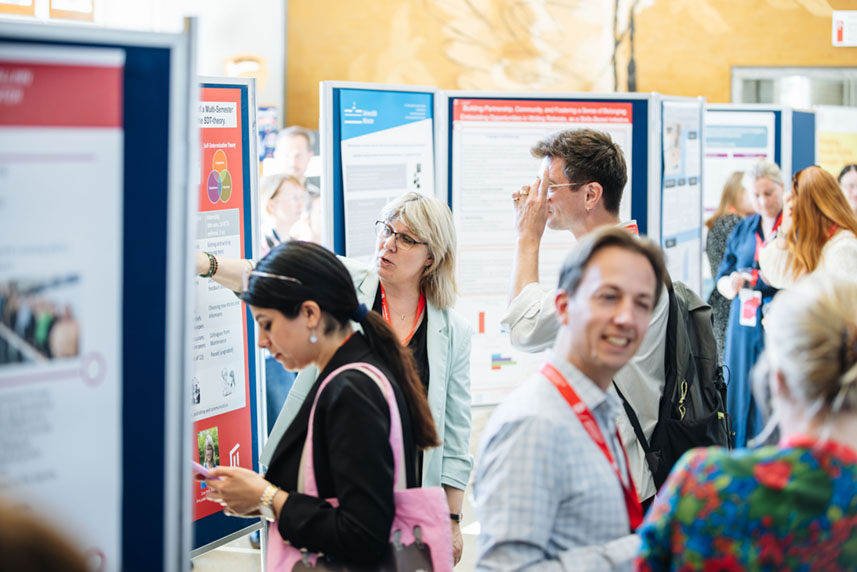
And what shifts when you are no longer working on your teaching questions alone
“What is SoTL, really?”
“Is it something for me?”
“And what actually happens at a conference like EuroSoTL?”
These were the questions I explored in a recent podcast conversation recorded during EuroSoTL in Groningen.
They are also questions I hear quite often.
And perhaps they all come down to a simpler one:
Are conferences like EuroSoTL still worth it?
It rarely starts with presentations
In higher education, many educators carry questions about their teaching and student learning.
Why are students not engaging as expected?
Why does something work in one group, but not in another?
These are good questions.
But they are often developed alone.
And that is usually where things slow down.
Why conferences still matter
What conferences like EuroSoTL offer is not primarily content.
It is context.
Time to think.
Space to talk.
And the presence of others working on similar questions about teaching and student learning.
In practice, the most important moments are rarely the formal ones.
A conversation over coffee that helps you rephrase your question.
A workshop where something suddenly becomes clearer.
A moment of recognition: this is not just my issue.
That is where something shifts.
A personal moment
I still remember my first ISSoTL conference in Bergen, 2018.
I expected interesting sessions.
What I did not expect was the atmosphere.
Open. Generous. Unusually kind.
People sharing work in progress.
Taking time for each other.
Being genuinely curious.
It felt, quite simply, like a warm bath.
(Which, in academic life, is not always guaranteed.)
From individual questions to shared development
What happens in spaces like EuroSoTL is that teaching questions stop being private.
They become shared.
And once that happens, they begin to change.
They become:
- more precise
- more grounded
- and often more manageable
You start to recognise patterns.
You borrow language.
You test your thinking.
Over time, SoTL becomes less about individual effort,
and more about shared development.
What this means in practice
This is where SoTL becomes an evidence-informed approach to improving teaching and student learning in higher education. In the podcast, we also touched on the Utrecht University Roadmap for SoTL.
One of the key ideas there is to take time to understand context before deciding what to change.
Interestingly, that is exactly what these conferences make possible.
They create the space to slow down, compare perspectives, and see your own teaching differently.
A small place to begin
If you are working on a question about your teaching, you might start here:
Where could this question be shared and explored with others?
Not to get answers immediately.
But to make the question better.
Questions like this often become the starting point for work on courses, programmes or professional development.
👉 You may also find it useful to explore more about SoTL support, the SoTL Summer School and EuroSoTL.
If you are curious, the podcast conversation from EuroSoTL offers a nice first impression of what this community and way of working looks like in practice.
Leave a Reply