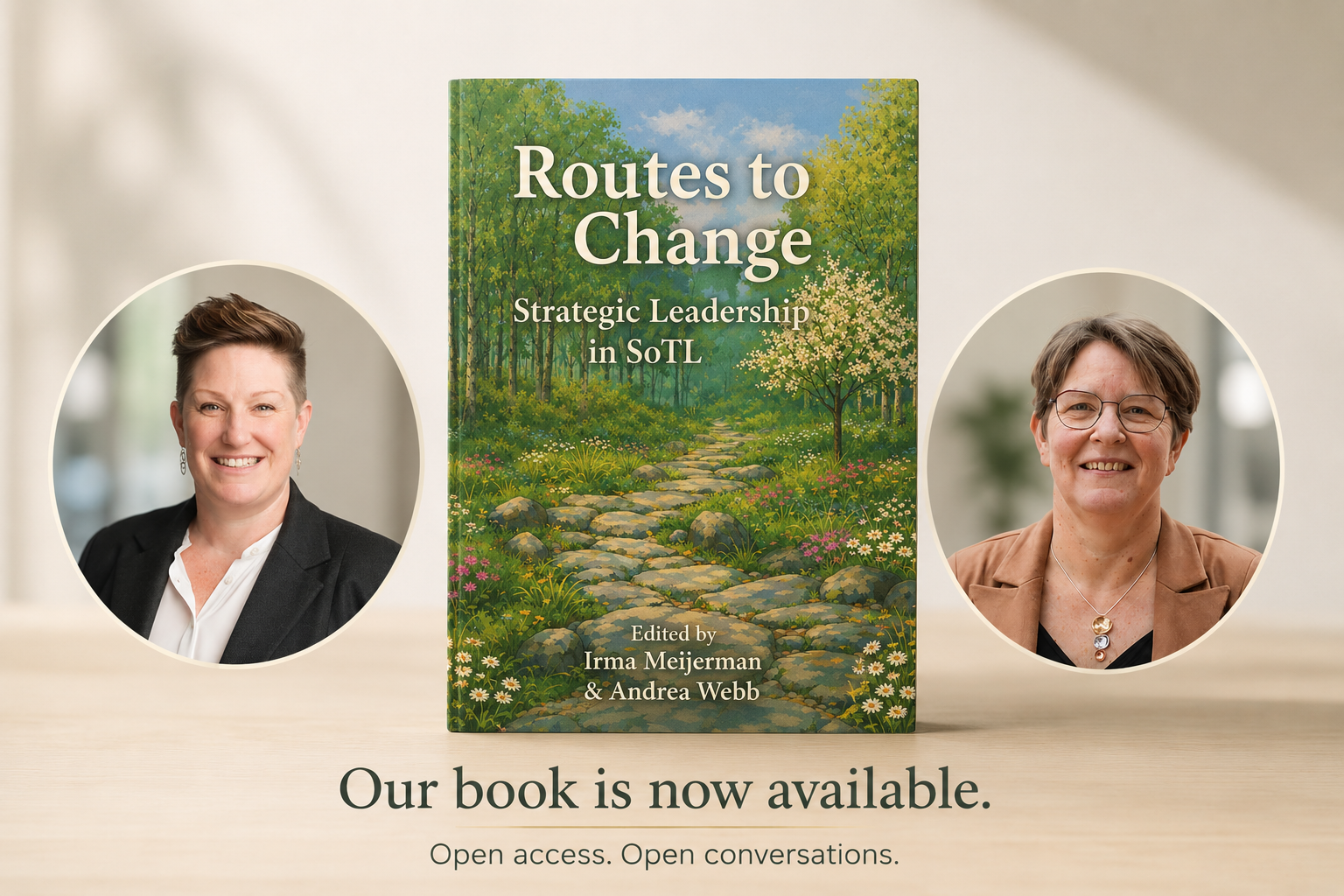
Today, 2 June 2026, feels like a fitting moment to post this blog, as Routes to Change – Strategic Leadership in SoTL is finally launched and openly available.
Over the past two years, Andrea Webb and I worked together with a wonderful group of authors from different countries, disciplines, and institutional contexts on this collection about SoTL leadership, educational change, and higher education. Somewhere between editing chapters, rewriting introductions, and quite a few early morning and late evening Teams meetings across a 9-hour time difference, I started noticing how often the same themes resurfaced.
Different countries.
Different institutions.
Different disciplines.
And yet, educators trying to improve teaching and learning often seem to run into remarkably similar questions.
Not the big strategic questions universities like to put in policy documents.
Usually much smaller and messier questions.
Why do some educational innovations gain momentum while others quietly disappear after one enthusiastic semester? Why does educational change so often depend on a few people holding things together behind the scenes? And why do so many people who are clearly influencing educational practice still hesitate to call themselves leaders?
That last question became particularly interesting to me while working on this book.
Because across many of the chapters, SoTL leadership and educational leadership rarely looked like formal leadership. It looked much more like people starting conversations about teaching and learning, connecting colleagues around educational questions, creating spaces for inquiry and reflection, supporting others in Scholarship of Teaching and Learning (SoTL), and quietly keeping educational ideas moving forward.
Often without formal authority.
And often without fully recognising their own influence.
One thing the book reinforced for me is that educational change in higher education rarely begins with institutional strategy documents. More often, it starts much closer to everyday educational practice: a frustration about student learning, a small teaching experiment, a conversation with colleagues, or someone asking: “Could we try this differently?”
Only later do some of these small initiatives begin influencing broader programmes, networks, or institutional cultures.
For me, that is also one of the reasons SoTL matters so much.
Not only as a way of studying and improving teaching and learning, but also as a way of creating educational communities where educators can think together about practice, student learning, evidence-informed teaching, and meaningful educational change.
And perhaps that is also why working on this book never really felt like “just editing a book”. It felt much more like being part of an ongoing conversation about teaching, learning, leadership, and educational change across higher education.
A conversation I hope will continue long after publication.
👉 Routes to Change – Strategic Leadership in SoTL is now freely available here: https://pressbooks.bccampus.ca/routestochange/
👉 For educators interested in SoTL and evidence-informed teaching: https://irmact.com/coaching-and-professional-development-for-educators-in-higher-education/
👉 For educational developers and teaching & learning centres: https://irmact.com/sotl-support-for-educational-developers-and-teaching-learning-centres/
Prefer a printed copy?
Routes to Change: Strategic Leadership in SoTL is available as a free open-access publication because we want its ideas to be accessible to everyone.
We’ve also produced a limited number of printed copies for co-authors, conferences, and colleagues who prefer having a physical copy.
If you’d like one, we’d be delighted to help while stocks last.
Printed copies
- Europe: €25
- UK: £20
- Canada & USA: CAD/USD 25
Whenever possible, we prefer to hand over printed copies in person at conferences. If you’d prefer to receive your copy by post, we’ll simply add the shipping costs.
If you’re interested, just send me an email at info@irmact.com.