
Many educators in higher education are already influencing teaching and learning around them.
They start conversations about education.
They help colleagues think through teaching challenges.
They introduce new ideas into programmes or teams.
They connect people who care about student learning.
And yet, very often, they would never describe themselves as leaders.
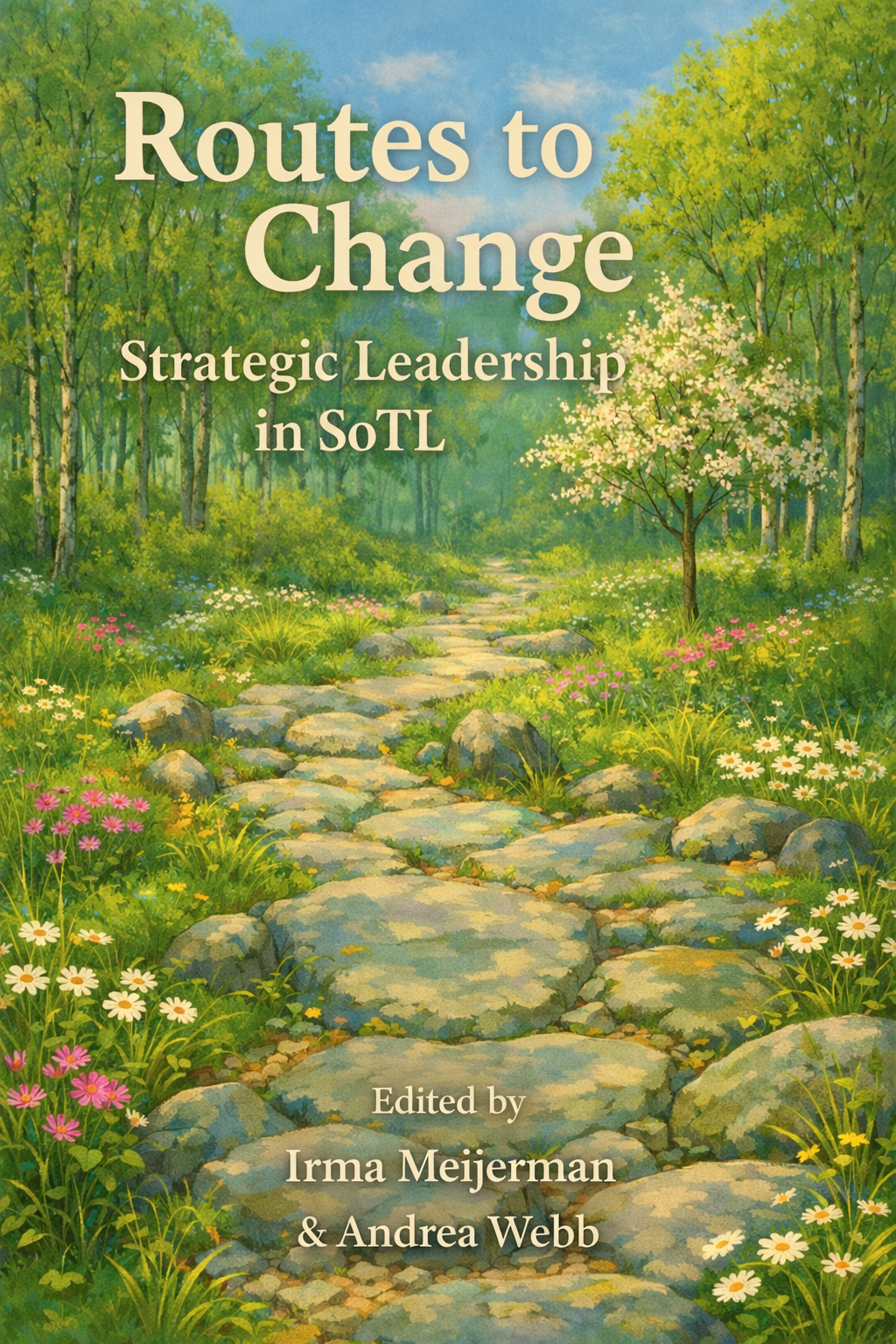
That observation became the starting point for Routes to Change – Strategic Leadership in SoTL, the open-access book Andrea Webb and I have edited together about Scholarship of Teaching and Learning (SoTL), educational leadership, and change in higher education.
For me, this question emerged gradually through my own work in higher education.
Originally trained as a toxicologist, I started my career as a researcher and lecturer at Utrecht University. Like many academics, I assumed that strong disciplinary expertise would naturally translate into effective teaching.
It quickly became clear that teaching and learning are far more complex than that.
Over time, I became increasingly interested in understanding what was actually happening in students’ learning. Why some educational approaches created deep engagement while others remained superficial. Why some educational innovations lasted, while others quietly disappeared after the initial enthusiasm faded.
That curiosity led me towards the Scholarship of Teaching and Learning (SoTL): an evidence-informed approach to improving teaching and student learning in higher education.
What I did not expect was that SoTL rarely remains limited to your own classroom.
Once you begin asking questions about teaching and learning, the work often expands naturally into conversations, collaboration, and supporting others. Without fully intending to, many educators and educational developers start influencing broader educational practices and cultures within their institutions.
That is where this book begins.
In Routes to Change, contributors from different countries, disciplines, and institutional contexts explore how educational change in universities often emerges through informal leadership, shared inquiry, communities, and small initiatives that gradually grow into something larger.
Andrea Webb and I edited this collection because we kept recognising the same pattern across higher education: meaningful educational change is very often carried by people without formal leadership roles.
The book brings together those diverse voices, experiences, and routes into SoTL leadership.
In the introduction of the book we reflect on our own routes into SoTL and educational leadership, and on the central question that kept returning throughout the editing process:
When does engagement become leadership?
We are now sharing the introduction of the book as an open resource.
👉 Introduction of Routes to Change – Strategic Leadership in SoTL is available here: https://pressbooks.bccampus.ca/routestochange/
You can also download the PDF.
I hope the chapter resonates not only with colleagues already involved in SoTL, but also with educators, programme leaders, and educational developers trying to create meaningful and sustainable change in teaching and learning within higher education.
A short reflection resource
While working on this book, I kept returning to another question: how often educators and educational developers are already contributing to educational change without recognising it as leadership.
Tha reflection became:
5 Signs You Are Already Leading Educational Change
(Even if you do not see yourself as a leader yet)
This short guide invites you to pause and reflect on how educational change often emerges through everyday practice, relationships, conversations, and small initiatives.
From reflection to practice
Many of these same themes also continue to shape my own work with educators, educational developers, and teaching & learning centres across higher education.
In different ways, much of that work revolves around supporting sustainable educational development: helping educators take feasible next steps in SoTL and evidence-informed teaching, supporting educational developers in building communities and cultures around teaching and learning, and helping institutions move beyond isolated initiatives towards more connected approaches to educational change.
If these ideas resonate with your own work or context, I would love to continue the conversation.
Further information about my work can be found here:
👉 For educators in higher education
👉 For educational developers and teaching & learning centres