One of the five principles Felten (2013) identified for good Scholarship of Teaching and Learning (SoTL) practice is that it should be conducted in partnership with students.
It is a principle that resonates immediately.
Of course students should be involved.
They are the ones experiencing our courses. They know what helps them learn, what frustrates them, and what sometimes makes no sense at all.
And yet, in practice, partnership often looks like this:
Students are interviewed.
Students complete questionnaires.
Students provide feedback.
Important? Absolutely.
Partnership? Not always.
Too often students become a source of data rather than genuine partners in the process.
Students as Partners in educational innovation
This question was very much alive in our department of Pharmaceutical Sciences at Utrecht University.
Pharmacy students were increasingly involved in educational projects, but their contributions often remained limited to sharing experiences and opinions. Valuable contributions, but not quite the same as actively shaping educational innovation.
So we started wondering:
How can students contribute to Scholarship of Teaching and Learning (SoTL) not only from their student perspective, but also as partners in educational innovation?
Together with colleagues — and three pharmacy students as members of the development team — we designed an elective course around that question.
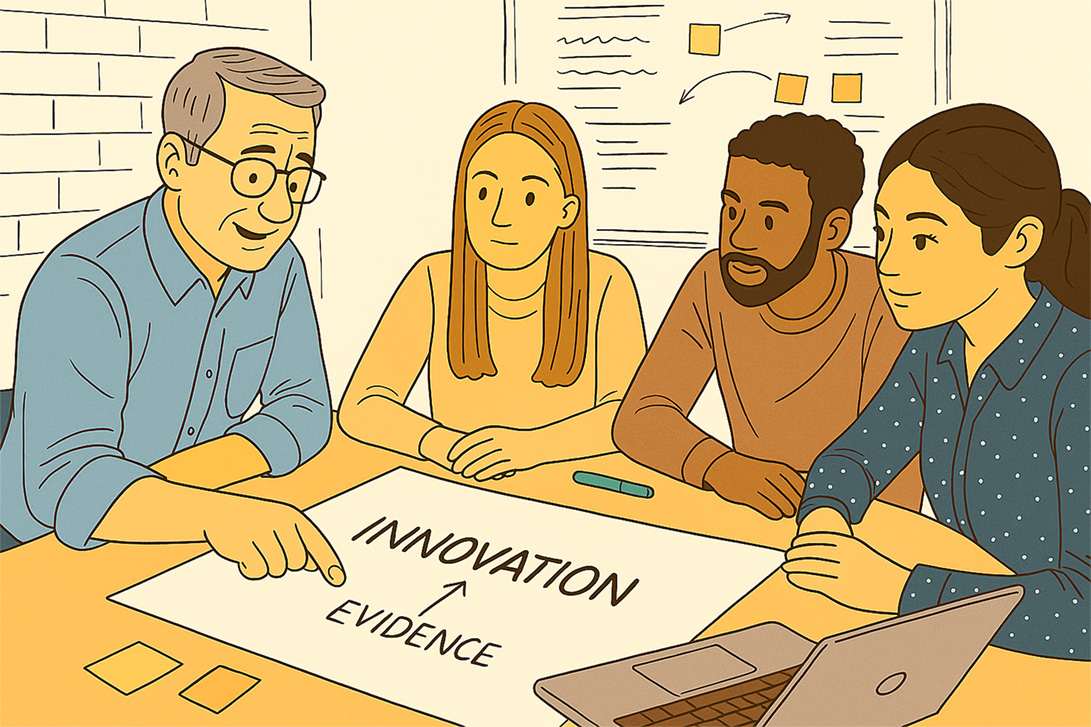
Bacherlor pharmacy students taking the elective were paired with a teacher. Together they explored a course, identified opportunities for improvement, developed a proposal for change, and thought carefully about how they could investigate whether that change would actually improve student learning.
That is SoTL in practice.
The first paper, published in Teaching & Learning Inquiry, describes the design of the course and what happened when students were given the opportunity to engage in educational innovation in this way. The study shows that students developed evidence-informed proposals that connected teaching activities, learning processes, and intended outcomes. Faculty members were enthusiastic about many of the proposed innovations and planned to take them forward in their own courses.
What students gained from the partnership
One of the most enjoyable parts of this project was seeing how creative the students were.
Their ideas went far beyond small adjustments or quick fixes. They approached educational challenges from different angles and came up with solutions that were both thoughtful and grounded in educational theory. Watching them make connections between teaching activities, learning processes, and student learning was genuinely inspiring.
Looking back, one of the strongest outcomes was not the course itself, but the confidence students gained to contribute to educational improvement.
I was equally inspired by working with the three students who helped design the elective itself: Lieke Maas, Veronia Nasralla, and Marit van Riessen.
Like many students, they initially questioned what they could contribute to a project about teaching and learning. None of them were educational experts. But throughout the process they discovered that their experience as learners was not a limitation — it was an expertise of its own.
Their reflections, published in the International Journal for Students as Partners, describe how they gradually became more confident, felt genuinely listened to, and started to see themselves as contributors to educational improvement rather than simply recipients of education.
Reading their reflections was a reminder that partnership benefits everyone involved.
The students learned about education, educational development, and SoTL.
I learned from their questions, ideas, perspectives, and enthusiasm.
And together we created something none of us would have designed alone.
What started as a course about educational innovation became a learning experience for everyone involved.
Read the papers
Both papers are open access and free to read.
Muliaditan, T., Meijerman, I., van Houwelingen, A., & Sweet, I. (2026). Incorporating Students as Partners in Educational Innovation: Development of an Elective Course. Teaching & Learning Inquiry. https://doi.org/10.20343/teachlearninqu.14.17
Maas, L., Nasralla, V., van Riessen, M., Meijerman, I., & Muliaditan, T. (2026). Reflective Insights on Co-Creating an Elective Course as Students as Partners. International Journal for Students as Partners. https://doi.org/10.15173/ijsap.v10i1.6680
Felten, P. (2013). Principles of good practice in SoTL. Teaching & Learning Inquiry, 1(1), 121–125. https://doi.org/10.2979/teachlearninqu.1.1.121
Together, the two papers tell the story from both sides: the design of a Students as Partners initiative in SoTL, and the experience of the students who helped create it.
👉 What does partnership with students look like in your own SoTL or teaching & learning practice?